MileApp vs 5 Fleet Management Apps: Which Fits Your Operation?
“Which one is better?” rarely has a single answer that works for everyone. The right choice between MileApp and other fleet and delivery management apps depends on the scope of your operation, how deep the features need to go, and whether you manage the whole cycle from route planning to proof of delivery or only one part of it.
This article compares MileApp, Deliveree, HashMicro, TransTRACK, Cartrack and Mekari against the same criteria, so you can shortlist the vendor that matches your requirements. It is written for operations, logistics and sales leaders running fleets or field teams across Southeast Asia.
Quick guide: when to choose MileApp, when to choose an alternative
MileApp is worth considering when your operation needs full control over three phases at once: Planning (route optimization, scheduling, clustering), Monitoring (live tracking, ETA/ETD, geofencing, telematics) and Execution (proof of delivery, digital workflows, no-code forms).
It is also a strong option for field sales and retail audit teams that need AI image recognition for out-of-stock (OOS) detection, planogram compliance and shelf analysis.
An alternative may fit better if your main need sits in one area only: GPS and fuel monitoring for a large fleet (TransTRACK or Cartrack focus here), logistics inside an ERP ecosystem (HashMicro), or a first introduction to delivery management concepts (Deliveree publishes good beginner content).
Mekari makes more sense if you already run its administration and accounting suite and want to add a fleet component.
Before you compare: check regional availability
Several vendors in this list were built for the Indonesian market. If you operate in Singapore, Malaysia, Thailand, the Philippines or across the region, confirm three things first:
- Local presence: Cartrack and HashMicro operate in several Southeast Asian countries. Mekari and TransTRACK focus mainly on Indonesia, and Deliveree runs its own on-demand network in a limited set of markets. Ask each vendor which countries they support with local staff.
- Data protection: check how the vendor handles personal data under your local law, such as the PDPA in Singapore, Malaysia and Thailand, or the Data Privacy Act in the Philippines, and where the data is hosted.
- Billing and invoicing: ask for a quote in your local currency and check whether the platform fits your e-invoicing requirements.
Feature comparison: side by side
The table below scores each vendor on the criteria that most often decide a purchase. “Available” means the feature is stated explicitly on the vendor’s product pages. “Not published” means we did not find it on the public pages we reviewed.
| Criteria | MileApp | Deliveree | HashMicro | TransTRACK | Cartrack | Mekari |
|---|---|---|---|---|---|---|
| Route optimization (multi-stop) | Available (TSP engine, multi-iteration) | Available | Available | Available | Available | Not published |
| Time windows | Available | Not published | Not published | Not published | Not published | Not published |
| Clustering / multi-trip | Available | Not published | Not published | Not published | Not published | Not published |
| Capacity constraints | Available (up to 10 constraints) | Not published | Not published | Not published | Not published | Not published |
| Live dashboard / ETA | Available | Available | Available | Available | Available | Not published |
| Telematics / IoT | Available (integration) | Not published | Not published | Available (highlighted) | Available (highlighted) | Not published |
| Driver behavior monitoring | Available (DSM AI, ADAS AI) | Not published | Not published | Available (highlighted) | Available | Not published |
| Geofencing | Available | Not published | Not published | Available | Available | Not published |
| e-POD (photo / signature) | Available | Available | Not published | Not published | Not published | Not published |
| No-code workflow builder | Available | Not published | Not published | Not published | Not published | Not published |
| API / ERP integration | Available | Available (logistics ecosystem) | Available (native ERP) | Available | Not published | Available (Mekari ecosystem) |
| AI image recognition | Available (OOS, planogram, shelf) | Not published | Available (Hashy AI, different scope) | Not published | Not published | Not published |
| Fuel & maintenance management | Not highlighted | Not published | Available (cost control) | Available (highlighted) | Available | Not published |
| Best for | Last-mile delivery, field sales, retail audit, end-to-end operations | Last-mile delivery, DMS beginners | Enterprise TMS/ERP, shipment planning | Large fleets, telematics-led, driver safety | GPS fleet tracking, delivery monitoring | ERP and logistics administration ecosystem |
Note: this data is based on information on each vendor’s public pages at the time of research. A feature that is not published is not necessarily unavailable, so confirm directly with the vendor.
MileApp pricing and total cost of ownership
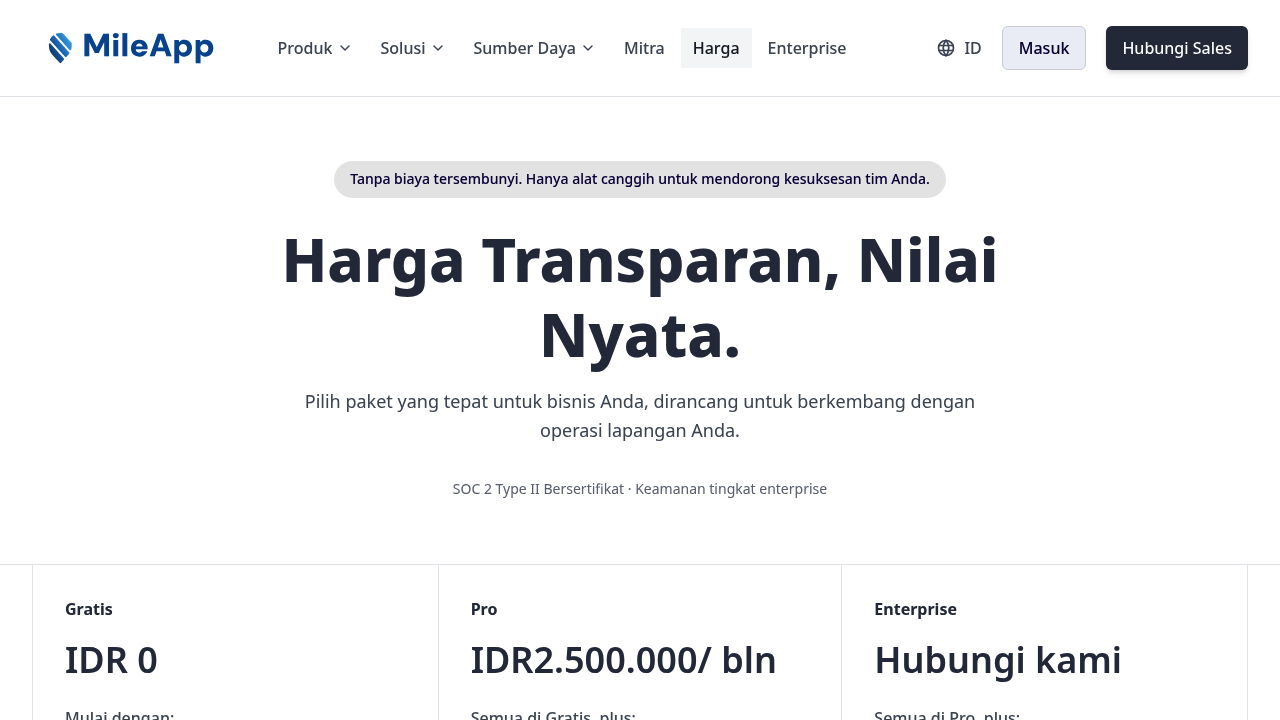
MileApp publishes its pricing openly. There is a Free plan with unlimited users and 1,000 tasks per month, and a Pro plan at IDR 2,500,000 per month with unlimited users, 2,500 tasks per month and 50 vehicles per route. Extra tasks cost IDR 1,000 each, with volume discounts at higher tiers. See the latest details on the MileApp pricing page. Prices are listed in Indonesian rupiah, so talk to our sales team for a quote in your local currency.
Most competitors in this list do not publish prices. Common cost structures in this segment are per vehicle per month (TransTRACK, Cartrack), per user or per module (HashMicro, Mekari), or based on transaction or shipment volume. For any vendor without public pricing, request a formal quote and compare every cost component.
TCO framework to consider
Total cost of ownership goes beyond the monthly licence. Include these components:
- Licence cost: monthly or annual price, including overage and add-on modules
- Hardware: telematics-led vendors (TransTRACK, Cartrack) usually require GPS devices installed in vehicles, which adds upfront and maintenance costs
- Integration: API development to your existing ERP, WMS or e-commerce systems
- Implementation and training: time to go live, data migration, onboarding drivers and dispatchers
- Operational change: updating SOPs, changing workflows and potential downtime during the transition
As an ROI reference, MileApp states that route optimization can cut travel time by up to 40%, and a Unilever case study showed a 24% increase in on-shelf availability. Use metrics such as fuel cost reduction, on-time delivery rate and idle time reduction to calculate your payback period.
Short profile of each vendor
1. Deliveree
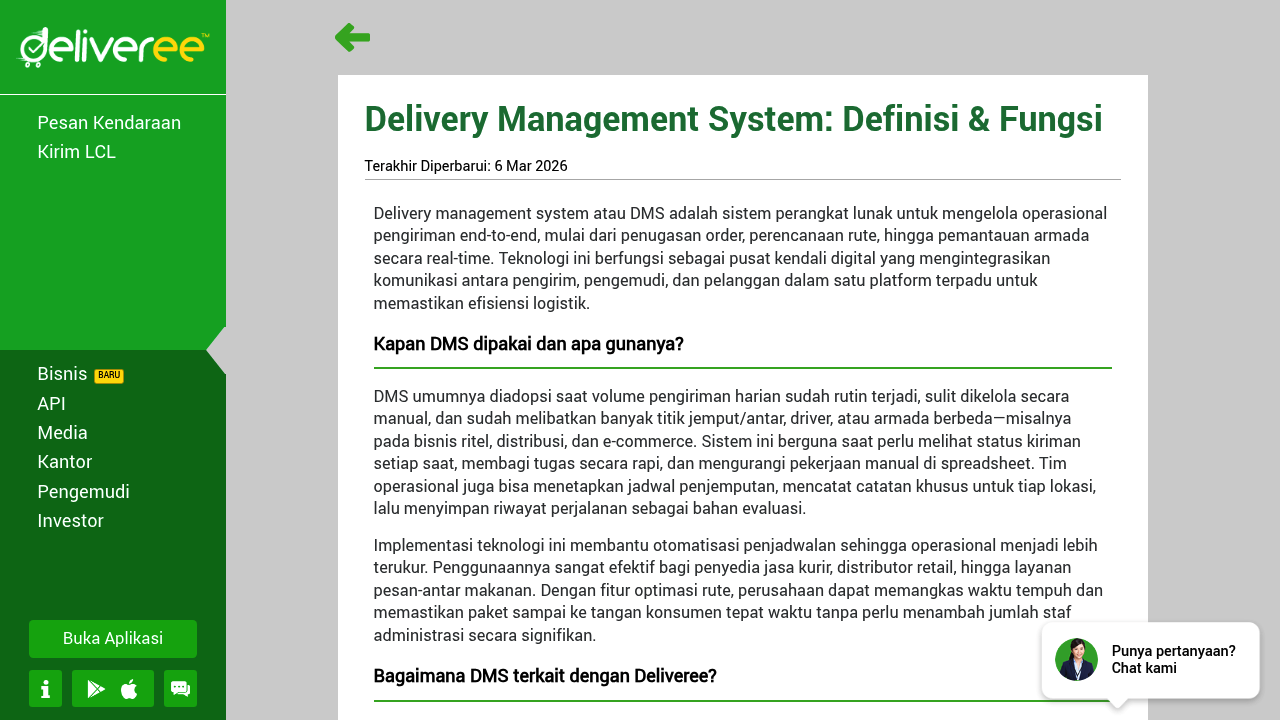
Deliveree stands out as an on-demand delivery platform with a network of partner drivers and educational content about Delivery Management Systems (DMS). Its strength is easy access to delivery capacity and a basic understanding of DMS for teams just starting to digitise logistics.
Limitations: thin technical content and no comparison tables or routing parameters on its public pages. A good fit for companies that need flexible, marketplace-based delivery. Less suitable if you need deep configuration such as time windows, clustering or field audit workflows.
2. HashMicro
HashMicro promotes a Transportation Management System (TMS) integrated with its ERP, covering shipment planning, carrier management, route planning and cost control. Its AI assistant, Hashy AI, is a highlighted differentiator.
Its strengths are deep ERP integration and credibility as an enterprise vendor. Limitations: no public pricing, no vendor comparison framework, and little detail on field execution (POD, no-code workflows). A good fit for enterprises that prioritise TMS-ERP integration. Less suitable for delivery operators that need detailed control over field execution.
3. TransTRACK
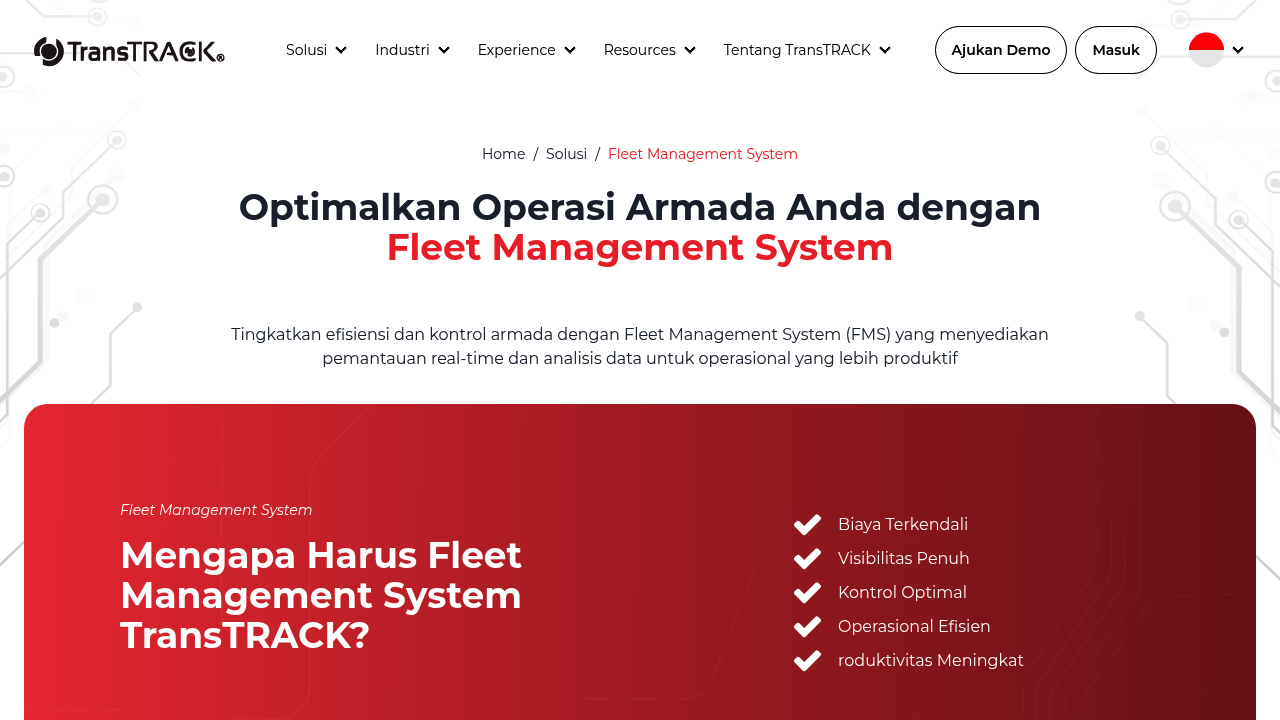
TransTRACK positions itself as a telematics-based Fleet Management System with real-time GPS tracking, route planning, geofencing, driver behavior monitoring, and fuel and maintenance management. Integrated dashboards and reporting are its core.
Its strength is clearly fleet monitoring and driver compliance. Limitations: field execution (e-POD, no-code workflows, field audits) is not highlighted on its public pages, and its focus is mainly the Indonesian market. A good fit for large fleet operators focused on vehicle monitoring and driver safety. Less suitable if your priority is digitising execution for couriers or field sales.
4. Cartrack
Cartrack highlights delivery fleet management that combines route optimization with GPS-based real-time monitoring. The platform has a strong focus on vehicle tracking and delivery telematics, and operates in several countries in the region.
Its strength is mature GPS tracking and fleet monitoring. Limitations: little end-to-end planning-to-execution coverage on its public pages, and no measurable ROI data or implementation checklist. A good fit for companies that prioritise vehicle visibility and on-time delivery. Less suitable for needs that require workflow automation and AI-based field audits.
5. Mekari
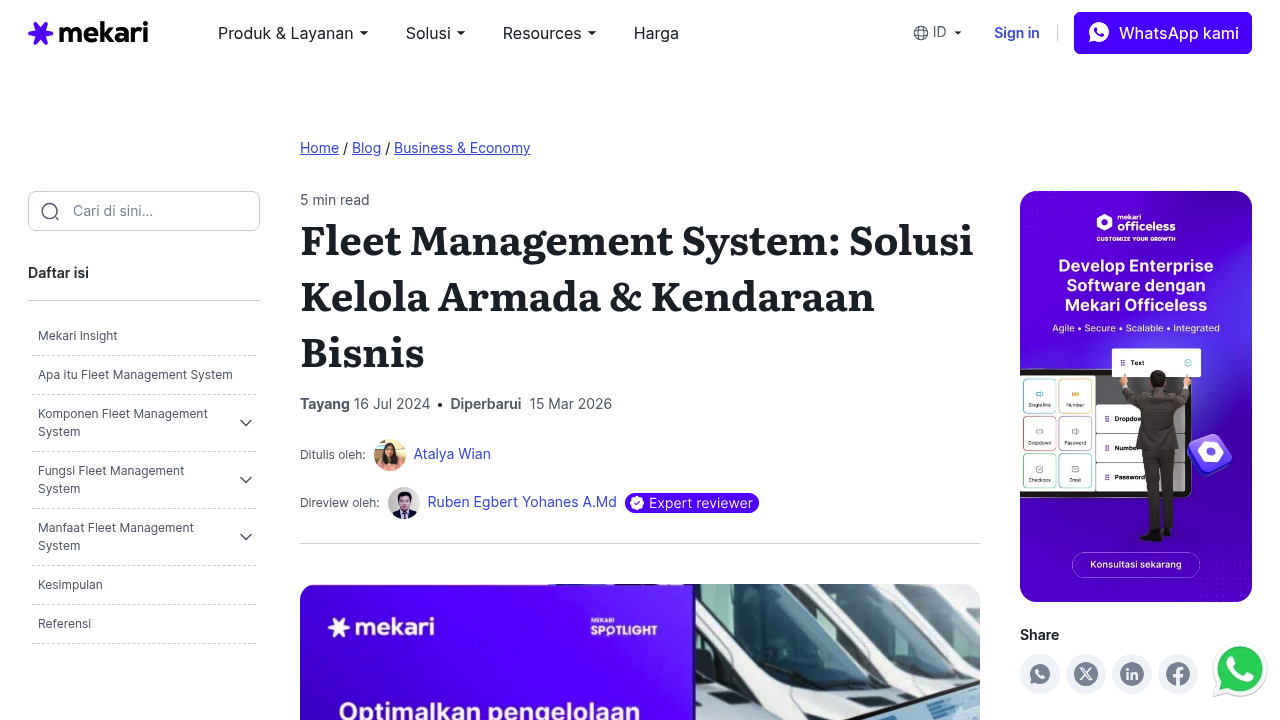
Mekari covers Fleet Management Systems within its wider administration and accounting ecosystem. Its content is structured to explain FMS concepts and benefits in general terms.
Its strengths are ecosystem integration and ease of adoption for existing Mekari users, mostly in Indonesia. Limitations: almost no decision framework, ROI data or actionable vendor comparison. A good fit for companies already in the Mekari ecosystem that want to add a fleet component. Less suitable as a standalone delivery or field execution solution.
Choosing by requirement profile
SMEs with a small delivery fleet
Key questions: do you need to optimize multi-stop routes every day? Do drivers need to submit digital proof of delivery? If so, you can start with the MileApp Free plan to test routing, live tracking and e-POD on one platform without an IT team, then upgrade when volume grows.
Enterprises and large logistics operators
Key questions: how many tasks do you run per month? Do you need to integrate with an existing ERP? The MileApp Pro plan (IDR 2,500,000 per month, 2,500 tasks, unlimited users, with volume pricing above that) suits high volumes with custom workflows. HashMicro is relevant if ERP integration is the top priority.
Retail execution and FMCG field sales
Key question: does your field team audit store shelves and record product availability? MileApp is the only platform in this list that explicitly publishes AI image recognition for OOS detection, planogram compliance and shelf detail, which matters for merchandisers and retail auditors working across modern trade and general trade outlets.
Large fleet operators focused on telematics
Key question: are fuel monitoring, maintenance schedules and driver behavior scores your main KPIs? TransTRACK and Cartrack are more specialised here. MileApp supports telematics and IoT integration, but if 90% of your needs are vehicle monitoring, a telematics-first vendor may go deeper in that area.
Evaluation checklist before choosing a vendor
Use this list during demos or a proof of concept with any vendor.
Technical checklist
- Does the system support multi-stop route optimization with time windows per stop?
- Is there clustering and multi-trip in a single planning session?
- How many vehicle capacity constraints are supported?
- Does live tracking show accurate ETA and ETD?
- Can geofences be configured per operating zone?
- Does e-POD support photos and digital signatures?
- Is there an open API to integrate with your existing systems?
- Can field forms and workflows be built without code?
Implementation checklist
- How many days to go live after the contract is signed?
- What master data needs to be prepared (vehicles, zones, delivery points)?
- Does the solution require hardware installed in vehicles?
- How are drivers and dispatchers onboarded, and is training available in your local language?
Operational checklist
- How responsive is the dashboard when routes change suddenly?
- Are delay or geofence breach alerts sent within seconds?
- Is there a complete audit log for compliance?
- What is the quality of technical support during peak hours in your time zone?
Business checklist
- Is pricing per task, per vehicle or per user? Which is cheaper for your volume?
- What is the minimum contract term (monthly or annual)?
- Is integration included in the package or billed separately?
- Can you be invoiced in your local currency, and does it fit your e-invoicing rules?
- How will you migrate from the old system without disrupting daily operations?
How to test vendors in real scenarios
Before deciding, run these scenarios during the trial or technical demo:
- Multi-stop with time windows: enter 20 delivery points with different delivery times and check whether the system produces logical, feasible routes.
- Task assignment and dispatch: simulate assigning tasks to several drivers at once and check whether changes appear in the driver app in real time.
- Geofencing alert: create a geofence around your warehouse and test whether an alert arrives when a vehicle leaves the zone.
- No-code POD form: build a simple delivery form (photo, signature, notes) without help from IT, then verify that the POD data appears automatically on the monitoring dashboard.
- POD-to-monitoring sync: make sure a task marked “done” in the driver app updates the dispatcher dashboard immediately without noticeable lag.
No single platform is perfect for every scenario. MileApp offers broad end-to-end coverage from planning to execution, with a no-code approach and published AI capabilities, making it a solid choice for teams that want to digitise all field operations on one platform. The other vendors in this list have more specific strengths in their own domains. Use the checklist and test scenarios above as an objective basis for evaluation before you sign any contract.
Want to see how it works for your fleet? Start with the free plan or book a demo with our team.